Navigating Japan's Adult Guardianship System: A Guide for Aging Expats
As you grow older in Japan, planning for potential loss of mental capacity is vital. Learn how the four levels of Japan's adult guardianship system work and how to set up a voluntary guardian.
YenWise Editorial
Japan personal-finance research for expats
For expats planning to spend their retirement years in Japan, estate planning involves more than just writing a will. An equally critical question is: who will manage your finances, sign medical consents, and make daily decisions if you lose mental capacity due to dementia, illness, or an accident? In Japan, this is managed under the Adult Guardianship System (成年後見制度 — Seinen Koken Seido).
The Four Levels of Japan's Guardianship System
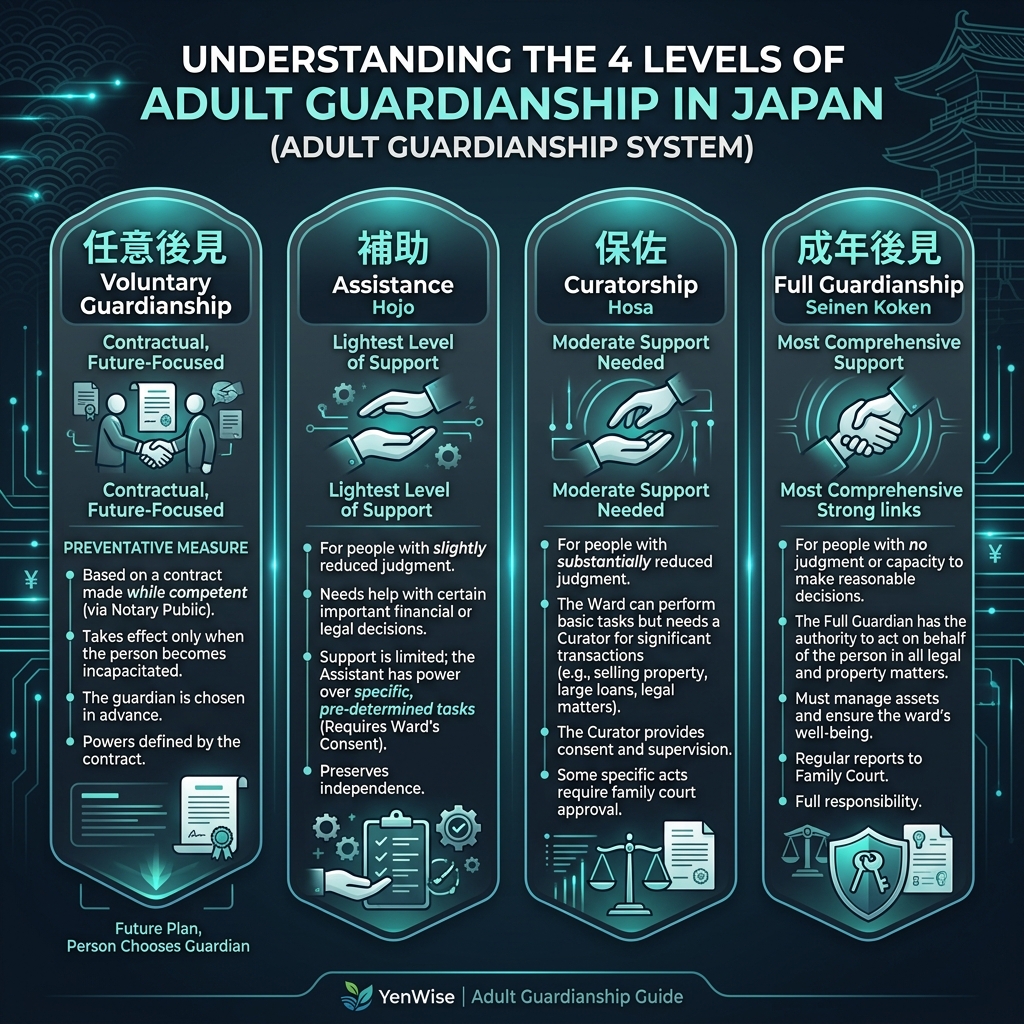
Japan's legal framework divides guardianship into two main tracks: statutory guardianship (法定後見), which is appointed by the Family Court after capacity is lost, and voluntary guardianship (任意後見), which is arranged via contract while you are still fully competent. Under statutory guardianship, there are three distinct levels based on the degree of mental capacity:
- Voluntary Guardianship (任意後見 — Nin'i Koken): Preventative. You choose your own guardian and define their powers through a notarized contract while you are still competent.
- Assistance (補助 — Hojo): For people with mild cognitive impairment. The assistant has limited power to consent to or cancel specific financial transactions.
- Curatorship (保佐 — Hosa): For people with substantially reduced judgment. The curator has broader powers to approve major decisions like selling property or taking loans.
- Full Guardianship (後見 — Koken): For people who lack judgment entirely. The guardian has comprehensive authority to act on the person's behalf in all legal and property matters.
How the Family Court Process Works
If a person loses capacity without a voluntary contract in place, a relative or municipal authority must petition the Family Court (家庭裁判所) to appoint a statutory guardian. The court requires a formal medical assessment from a doctor, which costs around ¥50,000 to ¥100,000. The court then reviews candidates and selects a guardian. Crucially, the court does not always choose a family member; in over 70% of cases, the court appoints a professional guardian, such as a lawyer (弁護士) or judicial scrivener (司法書士).
The Expat Choice: Voluntary Guardianship Contracts
To avoid having a court-appointed stranger manage your life, you can sign a Voluntary Guardianship Contract (任意後見契約). You must choose a trusted person—such as a spouse, an adult child, or a professional proxy—and execute a contract at a Notary Office (公証役場). When you eventually lose capacity, your chosen guardian petitions the court to start their duties. The court then appoints a voluntary guardianship supervisor (任意後見監督人) to monitor the guardian's actions, protecting you from potential elder abuse or financial fraud.
Key Planning Steps for Foreign Residents
- Act early. A voluntary guardianship contract is invalid if signed after you display signs of advanced dementia or cognitive decline.
- Choose a resident of Japan. The guardian must reside in Japan to handle local banking, rental contracts, and medical services.
- Draft bilingual instructions. While the contract submitted to the notary must be in Japanese, draft a parallel English letter explaining your wishes to your family and guardian.
- Consult specialized legal counsel. Seek a lawyer or judicial scrivener with experience handling cross-border assets and expat affairs.
For more details on legal procedures, see the Ministry of Justice Adult Guardianship Q&A and search for English-speaking legal support via the Japan Federation of Bar Associations.