Furusato Nozei: How to Get Free Wagyu, Fruit, and Sake from Japan's 'Hometown Tax'
Furusato Nozei lets you donate to rural Japanese towns and receive premium gifts worth up to 30% of your donation — while reducing your residence tax. It's not a loophole; it's government policy.
YenWise Editorial
Japan personal-finance research for expats
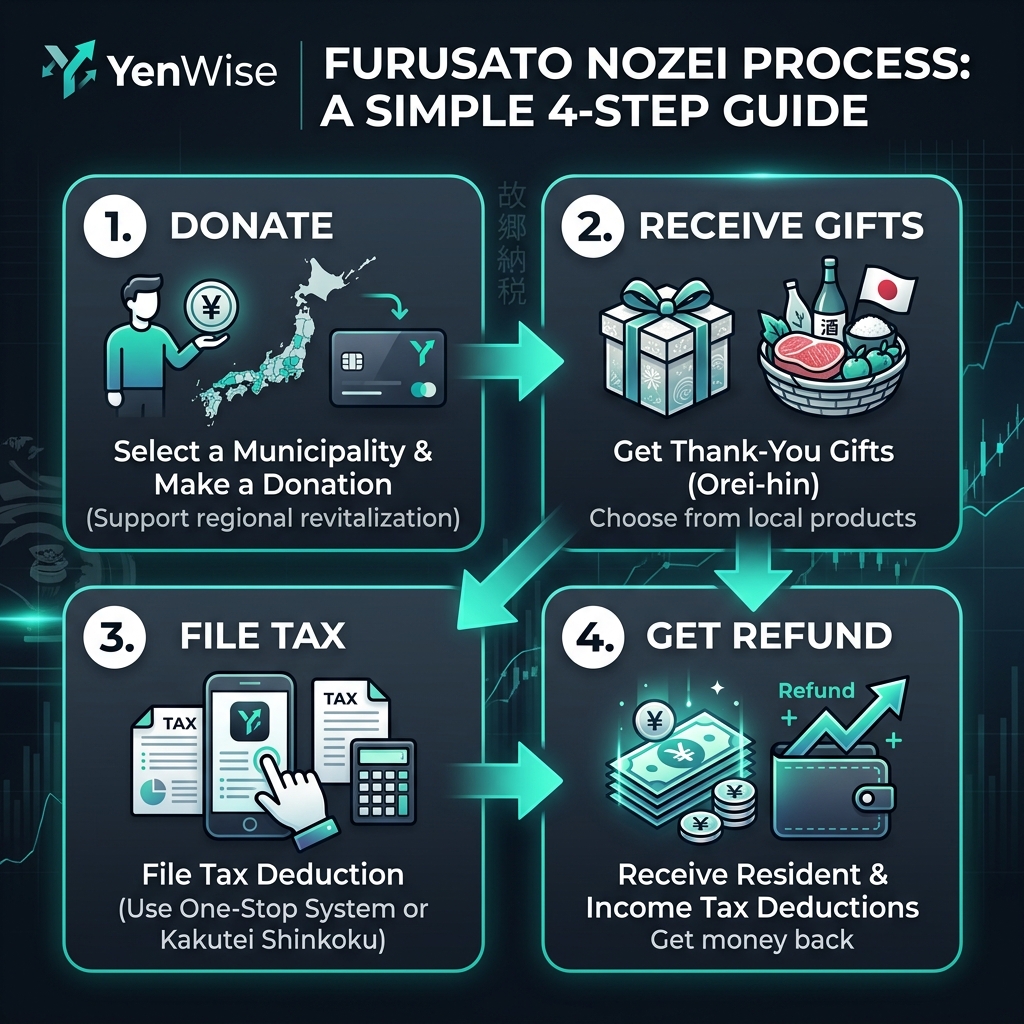
Furusato Nozei (ふるさと納税 — literally 'hometown tax donation') is one of the most popular financial programs in Japan — and it's fully available to expat residents. The concept is simple: you donate to a rural municipality, they send you premium local gifts, and you get nearly the entire donation back as a tax credit against your resident and income taxes.
How It Works: A Simple Example
Let's say you earn ¥6M/year and your residence tax is ¥300,000. You can donate approximately ¥60,000 to various municipalities:
- You donate ¥10,000 each to 6 different towns on Rakuten Furusato Nozei or Furusato Choice
- The towns ship you return gifts worth ~¥18,000 total (30% of ¥60,000)
- At tax time, ¥58,000 of your ¥60,000 donation is credited against your residence tax
- Your net cost: ¥2,000 (the mandatory self-pay portion) for ¥18,000 worth of gifts
How Much Can You Donate?
Your maximum donation limit depends on your residence tax levy and marginal income tax rate. The NTA formula is:
What Kind of Gifts Can You Get?
The return gift catalog is enormous — over 300,000 items across Japan:
- Premium food: Miyazaki wagyu beef, Hokkaido crab, Fukuoka mentaiko, Ehime mikan oranges
- Drinks: Niigata sake, Yamanashi wine, Okinawan awamori
- Household: Hokkaido rice (30kg), towels from Imabari, ceramics from Arita
- Experiences: Onsen vouchers, hotel stays, farm experiences
- Everyday items: Toilet paper, laundry detergent, diapers (yes, really)
Important Rules for Expats
- You must be a resident of Japan (any visa type) and pay residence tax
- Gifts are capped at 30% of your donation by government regulation
- If you donate to 5 or fewer municipalities, use the One-Stop Exception (ワンストップ特例) system — no tax filing needed
- If you donate to 6+ municipalities, you must file a Kakutei Shinkoku
- If you leave Japan mid-year, your residence tax for that year may be prorated — talk to your employer's payroll department
Where to Donate: The Best Portals
- **Rakuten Furusato Nozei** — Best if you use Rakuten points. Earn 1-10% back in points on every donation.
- **Furusato Choice** — Largest selection (300,000+ items). Clean interface, English-friendly product names.
- **Satofuru** — Curated high-end gifts. Smaller selection but higher average quality.
- **ANA Furusato Nozei** — Earn ANA miles on donations. Good for frequent flyers.
Pro Strategy: Stagger Your Donations
Don't donate your entire limit in December. Spread donations throughout the year to get seasonal gifts: sakura-themed sweets in spring, fresh peaches in summer, matsutake mushrooms in autumn, and snow crab in winter. Many items sell out early — the best wagyu and crab go fast in November.
How the ¥2,000 self-pay rule interacts with income
Furusato nozei is a donation-tax credit system: you choose municipalities, receive a thank-you gift in many cases, and claim credits so that only about ¥2,000 is a true out-of-pocket cost — if you stay within your limit. Going over the limit means you are simply donating. Income, family composition, and other deductions (including iDeCo) all change the ceiling. Use the Furusato Nozei Calculator before peak gift season.
One-stop exception vs full return
Salaried employees who meet the conditions can often use the one-stop exception (ワンストップ特例) instead of filing a full final return, but the rules are strict on number of municipalities and filing status. If you already file 確定申告 for other reasons, you generally claim furusato through the return. Mixing the two paths incorrectly is a frequent cause of missed credits.